Do LLMs Have Utility Functions?
Insights from choice experiments with financial portfolios.
Samford University
Western University
Introduction
LLMs as Economic Actors
Do LLMs need a utility function?
- AI agents are being deployed as autonomous decision-makers.
- These models are increasingly responsible for evaluating economic tradeoffs.
- Knowing how economic tradeoffs are evaluated becomes critical for alignment.
- However, the underlying preferences of these models remain largely unmapped.
Do LLMs adhere to the rationality axioms of utility theory?
Each principal deploying AI agents will want to understand their preferences, and potentially engineer alignment with the principal's preferences.
How LLMs Work
Choices from Autoregressive Distributions
How LLMs Generate Text
- $\tau$: temperature is the scale of the stochastic component.
A Typical Choice Experiment Prompt
Choose the portfolio you prefer and reply with A or B only.
Option A offers an expected return of 8% and
a standard deviation of 12%.
Option B offers an expected return of 10% and
a standard deviation of 5%.
The Core Insight
The LLM's choice mechanism is McFadden (1974)'s conditional logit.
Llama 3.1 8B Indifference Curve
Utility Axioms
Testing the Economic Rationality of LLMs
Utility Axioms
Complete: must express some preference or indifference.
The probability of selecting a choice label among the available options will be approximately 1.
\( P(A \mid x, \tau) + P(B \mid x, \tau) \approx 1 \)
Utility Axioms
Reflexive: any bundle of goods is at least as good as itself.
When options are identical, their probability of selection will be the same.
\( P(A \mid x, \tau) = P(B \mid x, \tau) \)
Utility Axioms
Continuity: there is a "tipping point" between being better than and worse than a given option.
Let $A\succ B\succ C$. There is a value $\epsilon\in [0,1]$ such that
\( (1-\epsilon)P(A \mid x, \tau) + \epsilon P(C \mid x, \tau) \)
\( = P(B \mid x, \tau) \)
Utility Axioms
Strong monotonicity: more (less) of a good (bad) is always better.
The probability of selecting a dominant option will always be higher than a non-dominant one.
\( P(A \mid x, \tau) > P(B \mid x, \tau) \)
Utility Axioms
Transitive: if $A\succ B$ and $B\succ C$, then $A\succ C$.
The probability of selecting A will always be higher than B, and B higher than C.
\( P(A \mid x, \tau) > P(B \mid x, \tau) \)
\( P(B \mid x, \tau) > P(C \mid x, \tau) \)
Experimental Design
A portfolio choice laboratory and a structural model of risk preference.
Portfolio choice laboratory
Binary menus over risky assets with known payoff moments.
Choose the portfolio you prefer and reply with A or B only.
Option A offers an expected return of [\(\mu_A\)]% and a standard deviation of [\(\sigma_A\)]%.
Option B offers an expected return of [\(\mu_B\)]% and a standard deviation of [\(\sigma_B\)]%.
Results
Rationality diagnostics, and inducing specific preferences.
Rationality diagnostics: Open Weight Models
Do LLMs satisfy the axioms of choice over risky portfolios?
| Model | Complete | Reflexive | Continuity | Monotonicity | Transitive |
|---|---|---|---|---|---|
| Qwen 3 (14B) | 0.9999 | 0.0002 | 1.0000 | 1.0000 | 0.9749 |
| Qwen 3 (8B) | 0.9999 | 0.0018 | 1.0000 | 1.0000 | 0.9923 |
| Gemma 4 (31B Instruct) | 0.9999 | 0.0000 | 1.0000 | 1.0000 | 0.9882 |
| Ministral 3 (8B Instruct) | 0.9995 | 0.0496 | 0.9667 | 1.0000 | 0.9643 |
| Gemma 2 (9B Instruct) | 0.9960 | 0.5236 | 1.0000 | 1.0000 | 0.9238 |
| Llama 3.1 (8B Instruct) | 0.9021 | 0.9250 | 1.0000 | 1.0000 | 0.9851 |
| Llama 3.1 (70B Instruct) | 0.7580 | 0.0648 | 1.0000 | 1.0000 | 0.9562 |
| Llama 3.1 (8B Fine-Tuned) | 0.9977 | 0.9966 | 1.0000 | 1.0000 | 0.9994 |
Rationality diagnostics: Frontier Models
Do frontier models satisfy the axioms of choice over risky portfolios?
| Model | Complete | Reflexive | Continuity | Monotonicity | Transitive | IIA |
|---|---|---|---|---|---|---|
| Claude 4.5 Haiku | 0.970 | 0.072 | 1.000 | 1.000 | 0.857 | 0.498 |
| Claude 4.6 Sonnet | 0.964 | 0.000 | 1.000 | 1.000 | 1.000 | 0.503 |
| GPT-4o | 0.998 | 0.009 | 1.000 | 1.000 | 1.000 | 0.301 |
| GPT-4o Mini | 1.000 | 0.008 | 1.000 | 1.000 | 1.000 | 0.586 |
| Gemini 2.5 Flash Lite | 1.000 | 0.000 | 1.000 | 1.000 | 0.987 | 0.802 |
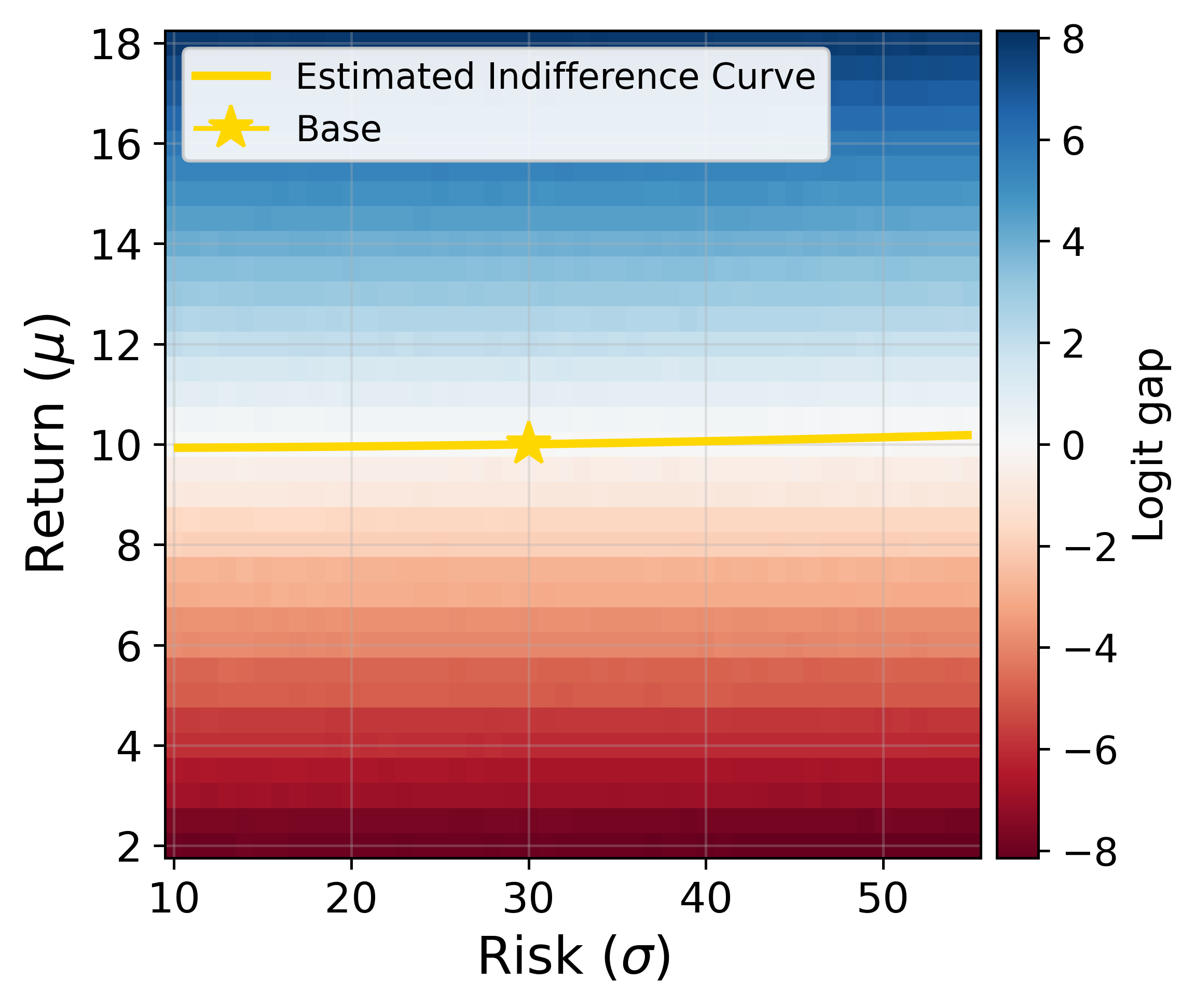
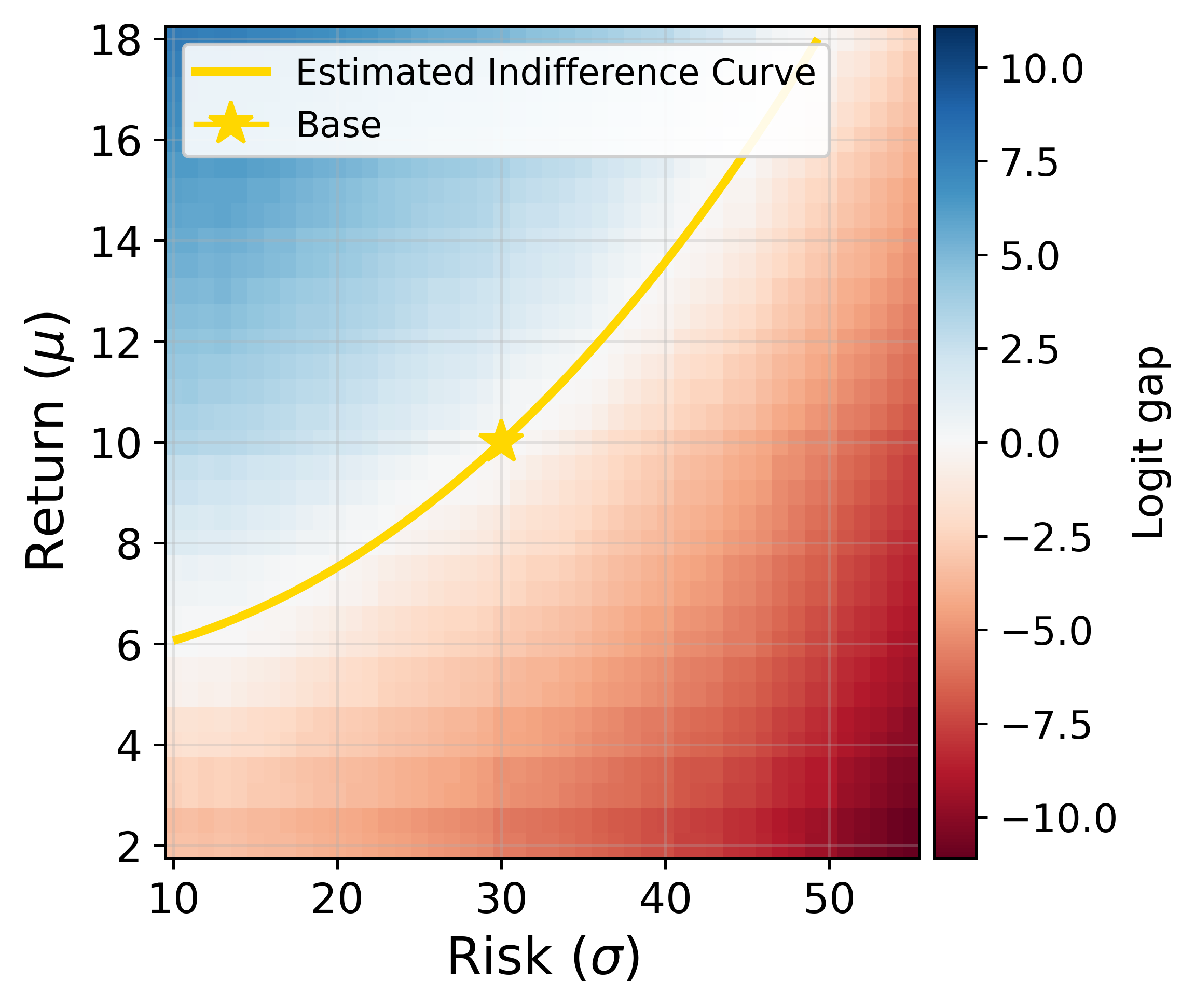
Fine-tuning Preferences
Conclusion
Contributions, limitations, and implications for agentic AI deployment.
Contributions & implications
- Formal equivalence between LLM softmax and the RUM. This places language model choice inside structural discrete choice methods, enabling recovery of cardinal utility indices directly from a model's single token logit outputs over choices.
- Experiments support the existence of a utility function. The results on our five axiom measures indicate the existence of a utility function over risky portfolios.
- Specific preferences can be induced via fine-tuning. Existing alignment pipelines allow for us to engineer the preferences of LLMs in a targetable way.
To deploy agentic AI, the models must be economically coherent and internally consistent. We show preferences governing their behaviour can be measured and targeted.
Thank you.
Fin.
Samford University
Western University
LLMs Live in Plato's Cave, We Project the Shadows

LLMs Are Ideal Experimental Subjects
- Environmental control for ceteris paribus variation.
- AIs are cheap and fast.
- AI never gets tired of answering your questions.
- Every simulation is "real" to the AI.